Posts Tagged ‘MV Scuba Adventure’

Marine life of Phuket – Harlequin Shrimps

Posted on January 25th, 2012 by admin-scubacat-dw  |  Comments Off on Marine life of Phuket – Harlequin Shrimps

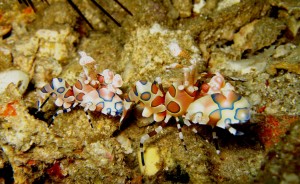
Harlequin Shrimps are a very flamboyant looking and a delight to see. There are two species of harlequin shrimps, namely the Hymenocera Picta found in Hawaii and Hymenocera Elegans found in Andaman Sea. They are commonly known as clown shrimp, painted shrimp and dancing shrimps.
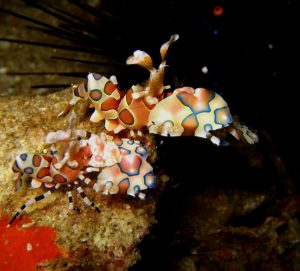
Scuba Cat Diving Phuket Thailand Harlequin Shrimps


The Harlequin shrimp is unlike other species in that it is a slow mover and not very agile. The beautiful bodies have stunning coloration with the body being a pinkish white or white with large purple edged pink spots. There may also be red and orange tones depending on the local environment.  The shrimps vary in size averaging between 2cm-4cm. The females are larger than the males and can be identified by the coloured abdominal plates. The male’s abdominal plates are white. It is believed that the vivid appearance of the shrimp is enough to deter predators. It also indicates that it may be toxic to eat as brightly coloured creatures often are. This is not the case with the shrimp. The two large flat pincers constantly move even when the shrimp is stationery, hence the common name “dancing harlequin shrimps”. The eyes are positioned on the end of stalks and the antennae are flattened, looking very leaf like.
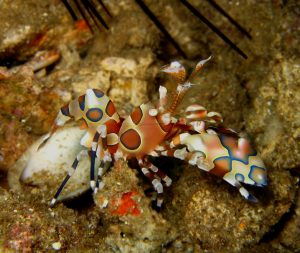
Scuba Cat Diving Phuket Thailand Harlequin Shrimp

Harlequin Shrimps are very shy and are found in mating pairs. They are monogamous and are very territorial usually covering an area of up to 10m square.  They are predominately nocturnal and will feed during twilight or under the cloak of darkness. During the day they are found in hiding places on a rocky or coral substrate.  This species of shrimp are rare and do suffer as a result of coral damage. The Indo-Pacific species is more common that the Hawaiian species, because over the years the latter has been actively collected for the aquarium trade.

Moulting occurs once a month. During this process the shrimp will hide until the new shell hardens. It is usual for simultaneous molting to occur. The molting also gives the opportunity for the shrimp to replace missing limbs, this may take more than one regeneration.  The mating couple will reproduce after the female as completed her molting process. She will lay between 100 and 5000 eggs per season and tends to them until they are hatched.
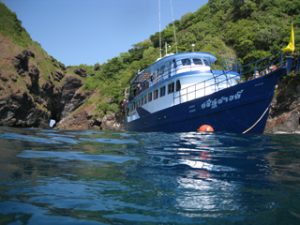
Scuba Cat Diving Phuket Thailand MV Scuba Adventure

The Harlequin Shrimps are predatory carnivores. They are ruthless and extremely strong. The shrimps work as a team and detect their prey by scent. They live on a diet of starfish. Once the starfish has been located the pair will prize the arms from the rock and overturn it, thus rendering the starfish helpless.  The starfish may be 10 to 20 times larger than the shrimps. It has been known for the shrimps to drag the starfish to the lair where it acts as a living larder. It is kept alive by the shrimps feeding it.  The shrimps dine on the tube feet starting at the tips and working inwards to the centre plate, thus keeping their food source alive for as long as possible. Occasionally, a starfish may detach an arm or two to make an escape!!!! It is fortunate that starfish have the capability to rejuvenate their limbs…..

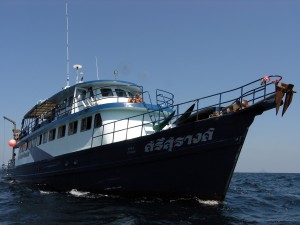
If you would like to know more about the identification of species why not sign up for on a  Underwater Naturalist Specialty Course, which will enhance your knowledge and highlight the key things to look for or a cruise on board MV Scuba Adventure or MV Scuba Fun for a chance to see these for yourself.
Hin Deang/Hin Muang Dive Trip Summer 2011 on MV Scuba Adventure- Vincent Moy Tour Leader

Posted on January 21st, 2012 by admin-scubacat-dw  |  Comments Off on Hin Deang/Hin Muang Dive Trip Summer 2011 on MV Scuba Adventure- Vincent Moy Tour Leader

I was very excited to take this trip out during the “summer season” as tour leader on MV Scuba Adventure. All season the local sites from Phuket had been performing so well, with lots of great visibility dives and an abundance of marine life both (very) big and small. I also knew that during the high season the dive sites of Hin Deang and Hin Maung are awesome, but I didn’t know what to expect from a trip this time of year?

Scuba Cat Diving, Phuket, Thailand MV Scuba Adventure

Scuba Adventure

… It was not a disappointment!

So here we go:

Day 1:

Shark Point – Great visibility to enjoy all the lovely soft corals, fans, sponges and tons of marine life including the odd leopard shark. Hi-light of the dive: a large marble patterned tiger tail seahorse.

Scuba Cat Diving, Phuket, Thailand  5 * CDC

Shark Point

Koh Bida Nok – Again tons of marine life, especially the trevally and schools of fusiliers, and a nice big hawksbill turtle at the start. Hi-light of the dive: absolutely the 10-20 black-tip sharks seen during the dive, especially getting up real close to 5-10 of them in the bay, before they finally torpedoed passed us.

Scuba Cat Diving, Phuket, Thailand  5 * CDC

Koh Bida Nok

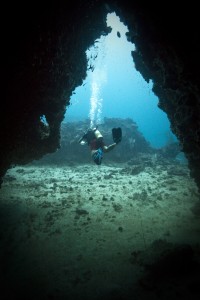
Koh Ha Yai – A beautiful late afternoon dive to enjoy the caverns (known as the Cathedral) and swim-through’s. Hi-light of the dive: the view looking out at the silhouetted divers the from the back of the Cathedral.

Scuba Cat Diving Phuket Thailand  5 * CDC

"The Cathedral"

Koh Ha Lagoon – A comfortable night dive in the protected lagoon between islands 2 and 4. Our group explored the east side wall of island 2 and the sloping reef between. Hi-light: For me the macro life amongst the vivid soft corals on the wall, for others the giant barracuda following us!

Day 2:

Hin Muang – Oh my God! The visibility! We could see the bottom… and which ever side you are on, it goes down a very long way! Lot’s of life; and the soft corals looking bigger and more colourful than ever. Hi-light of the dive: All of it, in stunning visability. It was like a scene from the movie The Abyss but with the lights on! Diving – the best reason in the world to get up with the sun.

Scuba Cat Diving, Phuket, Thailand Hin Mueng

"Stunning Visibility"

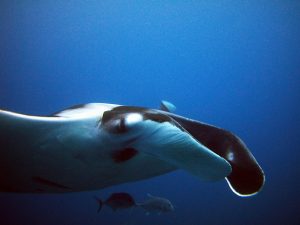
Hin Deang – Awesome vis continued, we could even see the outer pinnacle from the main rock! Whichever way you looked there was marine activity and mild currents meant an easy swim to appreciate it all. Hi-light of the dive: Did I mention the large manta ray that made it’s way around the rock to the outer pinnacle!

Scuba Cat Diving, Phuket, Thailand  5 * CDC

"Manta Ray"

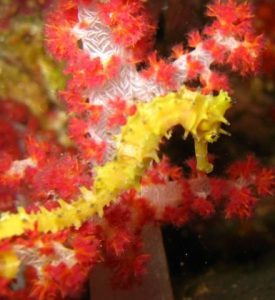
Koh Ha Neua – An early afternoon dive made the best of the huge purple soft corals on the southern side of this site. The shallow hard coral reef at the end of the dive was full of fish, whilst weaving in and out of the soft-coral coated rock channels rewarded us with nice nudi’s and a brilliant yellow tigertail seahorse. Hi-Light of the dive: A spotted eagle ray hovering over the purple soft coral field.

Scuba Cat Diving Phuket Thailand  5 * CDC

"Sea Horse"

Koh Bida Nok – With the currents reversed and an exciting dive the day before, we chose to go again from the other side of the island. This dusk dive showed us some more big fish (black-tip sharks), kuhl’s rays, mantis shrimps, morays, nudibranchs. Hi-light of the dive: I guess taking the time to see all the things we hadn’t noticed on the other dives – Bida Nok is one of the richest and most varied dive sites. Oh, and it being a dusk dive so some of us could visit Phi Phi Don and enjoy an evening on land.

Day 3:

Koh Bida Nai – Yet another sunny day, this early morning dive provided more sharks and a small school of big pick-handled barracuda. Hi-light of the dive: Swimming through the hundreds of fusiliers and trevally that hang out in the sunshine over the beds of stag horn coral, then back up the reef to the glittering chevron barracudas.

Scuba Cat Diving, Phuket, Thailand  5 * CDC

Koh Bida Nai

Anemone Reef – Of course anemones but also lots of colorful soft corals make this a beautiful pinnacle in good visibility… and it was! A turtle, lot’s of fish, little current, nudi’s and a few bamboo shark made it even better. Hi-light: A pale-yellow seahorse out in the sand (I like seahorses!)

Scuba Cat Diving, Phuket, Thailand  5 * CDC

Anemone Reef

Koh Doc Mai – A nice surprise… an extra dive thrown on to the end of the trip! This wall dive is awesome for macro – wonderful nudibranchs, ornate ghost pipefish, more bamboo sharks, all sorts of morays, this site can have it all. Hi-light: We got to dive again, ha!

Scuba Cat Diving, Phuket, Thailand  5 * CDC

Koh Doc Mai

Apart from the great visibility and relaxed diving (with it’s heart racing moments – sharks, manta, eagle ray), for me it was the wonderful variety of dive sites and marine life that made the trip one of the best. Also helping to make the diving awesome was that, during most of the trip, we were the only boat diving the sites… well, we were on the Scuba Adventure!

Liveaboards – MV Scuba Adventure

Posted on August 25th, 2011 by admin-scubacat-dw  |  Comments Off on Liveaboards – MV Scuba Adventure

When divers think of Thailand the first place that often they mention is Similans. But there are many more dive sites accessible in the South Andaman, which also offer the same diversity and topography as the North Andaman.

Some of these dive sites also have the advantage of being open for diving all year around as they have shelter and protection from the mainland.

South Andaman Dive sites can include:

Hin Daeng (Red Rock) and Hin Muang (Purple Rock):

Both of these sites are about 70 km south of Koh Lanta and offer the best of the South diving experiences. Here the visibility can be good, but the water is plankton rich so it attracts some of the larger marine life.

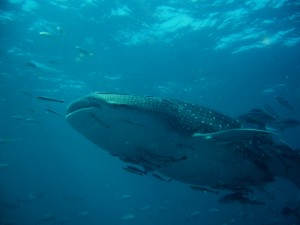
Scuba Cat Diving Phuket Thailand Whaleshark

"Whaleshark"

Hin Daeng is the deepest drop of in Thailand, with a wall descending to 70m+ on the south side of the site. It is visible from the surface in the form a three pinnacles that break the surface, these descend underwater to red soft coral covered walls and reef.

Hin Muang is a series of submerged pinnacles dropping down to 60m+, it is 200m in length and covered in purple colored soft corals.

The diversity of marine life on both sites ranges from the big palegics such as Manta and devil rays, Whale sharks and reef sharks, to small ornate ghost pipe fish, long nose hawkfish and nudibranchs.

Both sites are exposed during the monsoon season so are sometime inaccessible due to weather conditions.

Koh Haa:

This is a group of five islands about 25 km west of Koh Lanta. There are three dive sites here and it offers dramatic and colorful scenery. The reefs are hard coral which has soft corals and sea fans, the area has many swim throughs and caves.

Koh Haa Lagoon is a shallow, protected area that lies between 3 of the Islands, The central lagoon area is suitable for beginner divers and snorkellers and provides a safe, nursery-area for many juvenile fish species. You may see Porcupine Puffer Fish, Ghost Pipefish, Octopus and Hawksbill Turtles swimming amongst the corals

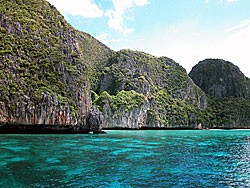
Scuba Cat Diving Phuket Thailand Koh Haa

"The Cathedral"

Koh Haa Cathedral is a series of large and spectacular, interconnected caverns and swimthroughs. The largest cavern has three chambers and is known as ‘The Cathedral’. The first two chambers are connected by a shallow swim through at about 9 metres. It is possible to surface inside the Cathedral and see the limestone stalactites looming from the high ceilings. Light floods in through the two large entrances and offers great photographic opportunities. The shallow area in front of the beach is packed with coral and is suitable for beginner divers. Look out for the coral formations that are several metres high.

Koh Haa Chimney at Ko Haa Neung is a tall, vertical chimney, often filled with small glassfish or sweeperfish, starting at 5m and going down to around 16m. Explore the arm that branches out to the east, bringing you out into a beautiful shallow chamber with several large exits. You can find banded sea snakes, lionfish, nudibranchs, frogfish, harlequin shrimps, many other crustaceans and beautiful cowries. Look for large schools of snapper and barracuda.

Phi Phi :

Phi Phi islands have many dive sites, but the most famous and rewarding are at the south and are two rock islands called the Bida’s, Nok and Nai.

Scuba Cat Diving Phuket Thailand Phi Phi

"Phi Phi"

There is also a wall near to Maya beach, made famous by the movie the Beach with Leonardo De Caprio, which offers good diving.

The diving offers walls and sloping reefs, with hard and soft coral, many large sea fans and anemones. Schools of jack fish, barracuda, snappers can be seen on all sites, with sea horses, ghost pipe fish and nudibranchs. Look out for leopard sharks in the sandy areas with stingrays, and in the shallow look for hunting black tip reef sharks.

Turtles both green and hawksbills can often be found at all sites but many are seen on Maya wall.

Shark Point and Anemone reef :

Located around 26km from Chalong bay these two dive sites are less than a km away from each other. Anenome reef is one submerged pinnacle and Shark Point is two pinnacles, with one slightly above the water line.

Both sites are covered in soft corals with gorgonian sea fans, barrel sponges and anemones, and they attract a large amount of marine life.

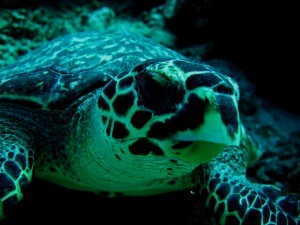
Scuba Cat Diving Phuket Thailand Turtle

"Turtle"

Leopard and bamboo sharks can be sighted here, along with tigertail sea horses, hawksbill turtles and cuttlefish. Schooling snapper, travalie and fusileers are common, with many lion fish, scorpion fish and different types of moray eels.

Koh Doc Mai :

The name means flower island in Thai and the dive site is a limestone island with vertical walls descending to 24 to 28m in depth. The East side is the most dived and has two caves along its wall, there are many crevices, big sea fans, whip coral and tree corals.

The site offers a good variety of macro life, tiger tail sea horses, ghost pipe fish, nudibranchs, many types of shrimps and frog fish. Many white eyes morays are found together and under ledges bamboo sharks are common. The dive is normally a one way drift along the wall.

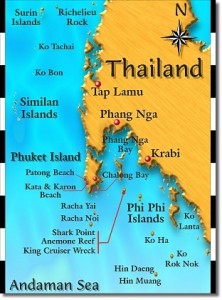
Scuba Cat Diving Phuket Thailand Dive sites

"Andaman Sea"

If you want to enjoy the best sites that Phuket all around the Andaman Sea can offer in a 7 day liveaboard trip join MV Scuba Adventure from November to May.

MARINE PARK RULES AND REGULATIONS

DO NOT 

Collect anything except rubbish

Make loud noises, which disturb other people and wildlife.

Hunt, destroy, or do anything that harms plants, animals and the environment

Exceed 40m of depth if trained; entry level divers must not exceed 20m of depth.

Exceed no decompression limits

Dive in restricted areas

Feed any animals

Dive with gloves, (except on wreck dives and mooring line descent or ascent dives).

DO

Have a diving certification

Realise the significance of nature, in that we must share and learn to preserve it for ourselves and others.

Have a signaling device

Complete safety stops on every dive

Protect the environment with good buoyancy control

Take the Master Scuba Diver Challenge – Enriched Air Diver Specialty (Nitrox)

Posted on August 23rd, 2011 by admin-scubacat-dw  |  Comments Off on Take the Master Scuba Diver Challenge – Enriched Air Diver Specialty (Nitrox)

Scuba Cat Diving has been offering the Nitrox Enriched Air Specialty since ‘s introduction of the course in 1996. Once considered to be dangerous, it now is widely accepted and very accessible. Diving with Nitrox Enriched Air allows us to safely extend our bottom times and after all, time underwater is what it’s all about!

Scuba Cat Diving Phuket Thailand Enriched Air

Since its introduction in recreational diving 1985, Nitrox Enriched air has slowly changed from being controversial to widely accepted. It is now our most popular Specialty Program and all our Daytrip boats are equipped with Oxygen Clean Compressors, which enables us to make Enriched Air available to all Nitrox certified customers.

Diving with Nitrox Enriched Air is most beneficial on dives between 18 and 30 meters. The reduced Nitrogen in the breathing gas means less Nitrogen loading and thus longer dive times.

What is Nitrox?

The air we breathe every day typically consists out of 78% Nitrogen, 21% Oxygen and 1% other gasses. In simple terms, Nitrox Enriched Air in Scuba Diving is any breathing max with an oxygen percentage exceeding 21%. The most popular mixes are EANx 32 (with 32% oxygen) and EANx 36. For recreational diving, breathing gases enriched to 40% oxygen are acceptable and up to 60% with Semi Closed Rebreathers.

Scuba Cat Diving Phuket Thailand  5 * CDC

Most scuba equipment, including regulators, BCD’s and dive computers are compatible with Nitrox Enriched Air up to 40% when they come from the factory, however you should check the manufacturer’s guidelines.

The normal air we use in scuba diving mainly consists out of Nitrogen (approx. 79%) and Oxygen (approx 21%)*.  Dive tables and computers are based on calculation of theoretical Nitrogen loading. This loading is expressed in Foot Sea Water (fsw), which is directly related to the Partial Pressure of Nitrogen. So, as most divers already know, the nitrogen loading is based on the depth of the dive and the amount of time we spend underwater. Besides these two elements, the third factor that determines our nitrogen loading is the percentage of Nitrogen in the gas we breathe.


In Scuba Diving, Enriched Air Nitrox is any gas mix with more than 21% oxygen. Our body doesn’t use the extra oxygen in the mix, but we do benefit from the reduced Nitrogen. The reduced nitrogen will reduce the partial pressure of nitrogen when we dive and reduce the nitrogen loading, thus extending our bottom time.

Nitrox Enriched air was first introduced as a recreational breathing gas in 1985, which caused major controversy among Scuba Diving experts. It took another 11 years before it became widely accepted with ‘s support of Nitrox Enriched Air as a recreational breathing gas and its introduction of Educational Material and the Nitrox Enriched Air Speciality course in 1996.

Most dive centres have Nitrox Enriched Air available and some boats have Nitrox available onboard.

Scuba Cat’s MV Scuba Adventure, includes several free Nitrox fills on every trip to allow longer dive times. MV Scuba Fun and MV Scuba Cat both have the facility for Nitrox on board meaning that you can take your Enriched Air Diver Specialty during your diving with us no matter which boat you are on. The course is available as a Elearning course, so you can complete the theory from your own home and enjoy the diving on your vacation.

Scuba cat Diving Phuket Thailand  5 * CDC

Similan Islands – What are they?

Posted on August 20th, 2011 by admin-scubacat-dw  |  Comments Off on Similan Islands – What are they?

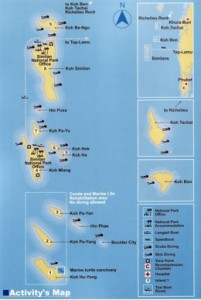
The Similan Marine Park is located 70km west of Thailand Phang-Nga province. This group of islands is considered to be one of the top dive destinations in the world, mainly due to the clear water that surrounds the islands.

Scuba Cat Diving Phuket Thailand Similan Islands

Similan was derived from the Malay work for nine “Sembilan” as the little archipelago is made up of nine islands. The islands do have local individual names, but are usually referred to by their respective numbers from North to South.

The Similan’s were designated as a National Park of Thailand in 1982 and cover an area of 128km2, which includes Koh Bon and the two rocky outcrops of Shark Fin Reef and Hin Pusa.

In 1998 an extra 12km2 of area was added when Koh Tachai was added to the park, which is now a total area of 140km2, of which only 15km2 is land.

Most of the islands are uninhabited with the exception of Islands 4, 8 and koh Tachai, which have national park offices located on them.

With the nine islands you get a wide variety of experiences, activities and stunning views, there are white sand beaches and massive boulder formations.

Underwater there are amazing coral gardens and diverse marine life ideal for all divers.

Scuba Cat Diving Phuket Thailand Similan Liveaboards

The topography differs between the eastern and western sides of the islands. The east side consists of sandy bottoms with wide and colourful soft and hard coral fields that slope down to 40m in some areas. They have gentle current and make for easy diving.

The west side is characterized by large, stacked granite boulder formations which create tunnels and archways with impressive scenery. Currents here can be unpredictable which can make the diving more challenging for beginner divers. But this side is exposed to the open sea and provides good opportunities to spot big pelagic life.

Island 1               Koh Hu-Yong

The second largest island lies 8km south of island 4, it has the largest white sand beach of the Similan National Park which is located on the north side of the island. The beach is a protected area and has a Turtle hatchery, you need special permission from the forestry department to enter this island.

Island 2 and 3     Koh Pa-Yang and Koh Pa-Yan

These two islands are also protected, their topography is granite boulders with mountains and cliffs, no beaches. At resent all the first 3 islands are closed to diving in an effort to preserve the underwater environment. The most southern dive sites are the rocky outcrop of Shark Fin Reef and the submerged site of Boulder City.

Island 4               Koh Miang

The island has a marine park office, camping, small bungalows and a fresh water supply. There are 2 beaches, Haad-Yai or Princess beach on the north and Haad-Lek or Honeymoon beach to the East. There is a trail that runs between the two through the forest. Also on the island is a view point where once you reach the top has a spectacular view of the south islands of the Similans, the trek to get there is a little energetic though.

Islands 4 and 5   Koh Ha and Koh Hok

These two islands are located to the East of Island 4 and are the smallest in the group. The landscape underwater is spectacular with both fringing reef and boulder formations.

Island 7               Koh Pa-Yu

The island has a combination of granite formations and sand beaches. The East side of the island is now closed to diving, but the north and west sides offer rocky pinnacles as dive sites which are covered in soft corals. Again these sites are open to the ocean so currents can be encountered along with the bigger pelagic life.

Hin Pusa

Is located between islands 7 and 8 and is a group of boulders known as “Elephant Head Rock” as the shape resembles the head of an elephant. The site is recommended for experienced divers due to the depth and current.

Island 8               Koh Similan

Is the highest and largest of the islands and has a marine park office and camping in the North of the island at Donald Duck Bay. It is also where the famous Sail Rock is located which is a symbol of Similan. The view from the Rock shows the North part of the Similans. There is no diving on the west or East side of the island, leaving only the North area available.

Island 9               Koh Ba-Ngu

The island has no beach, but is a favorite with divers due to the scenery underwater, it has a mix of coral reef and rocky outcrops.

Scuba Cat Diving Phuket Thailand Koh Bon Similan Islands

Koh Bon

The island is North east of Similans, with no sand beaches it is a limestone island with an unusual “hole” which traverses the island on the west side caused by sea erosion. The most popular dive is the ridge where a cleaning station for Manta Rays can be found.

Koh Tachai

This is most Northern part of the Similan Marine Park.  The island has a beautiful white powder beach where the park office is located. With many dive sites including a plateau to the south it is a popular dive destination.

Richelieu Rock

Although not part of the Similan marine park this is often dived on the same liveaboard trips. It is actually part of the Surin Marine Park and is located between the mainland and Surin islands. It is a submerged pinnacle know for it colourful soft coral and rich diversity of life, which can include the smallest creatures such as ghost pipe fish and sea horses to the largest of whale sharks and Manta rays.